 |
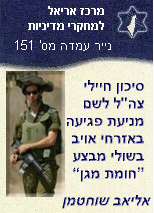
Endangering IDF Soldiers
in Order to Avoid Harming Enemy Civilians
in the Wake of Operation
“Defensive Shield”
Eliav Shochetman
Policy Paper No. 151 (Hebrew), 2004
|
Operation “Desert Shield”, upon which
Israel embarked in order to rout the terrorist infrastructure and strike at
the terrorist organizations, which have long been perpetrating the
systematic massacre of men, women and children, placed several questions on
the public agenda, among them those relating to military morality and purity
of arms in Israel.
This paper is devoted to one of those
questions and the relevant facts for our purposes are the following: In the
framework of Operation “Protective Shield”, (Spring 5762/2003), IDF forces
entered Arab cities in Judea and Samaria in order to apprehend fugitives and
liquidate terrorist infrastructures. Among other places, the IDF also took
action in the city of Jenin, including the refugee camp located therein,
from which several of the perpetrators of the most severe catastrophes,
which befell Israel in the wake of the recent suicide bombings, had
embarked. After most of the residents of the refugee camp heeded the IDF
call to evacuate the area, IDF commanders requested authorization to bomb a
certain defined area in the camp from the air, in order to avoid inevitable
casualties among the ground forces. Authorization was not granted and as a
result, on April 9, 2002, a ground operation was initiated, in the course of
which, 13 IDF soldiers were killed. The IDF Commander of the Central
Command, when asked why the site had not been bombed from the air, responded
that it stemmed from the desire to avoid civilian casualties. A senior
officer in the combat force said, that he “prefers that a soldier be killed
rather than a Palestinian woman".1 In a
newspaper interview, the then Defense Minister, Binyamin Ben-Eliezer,
confirmed that it was he who had ordered the ground operation, in order to
avoid bombing from the air – which was liable to cause civilian casualties
among the refugee camp residents who remained at the site.2
-
HaZofeh, 25 Nisan, 5762.
-
Maariv, 20 Sivan 5752 (An
article by Sari Makover, “I Will Be Prime Minister”, “Weekend” supplement,
p. 18). See also the articles by Danny Shalom, HaZofeh, 2 Tammuz
5762, and Assaf Buznak, Tel Aviv Magazine, August 2, 2002. Further
expression of this policy was also given in the ruling of the Supreme
Court, H.C. 4/02-3116, Bracha v. Defense Minister and Others; Tibi v.
Prime Minister and Others; Adallah – The legal Center for the Rights of
the Arab Minority in Israel and Others v. The Commander of the IDF Forces
in the West Bank, P.D. 56(3) 11, which dealt with a different aspect of
the Jenin battle in question, in which it said that “the army fought from
house to house and not by dropping bombs from the air, in order to prevent
possible civilian casualties.”
For the complete article (in Hebrew),
click
here.
|